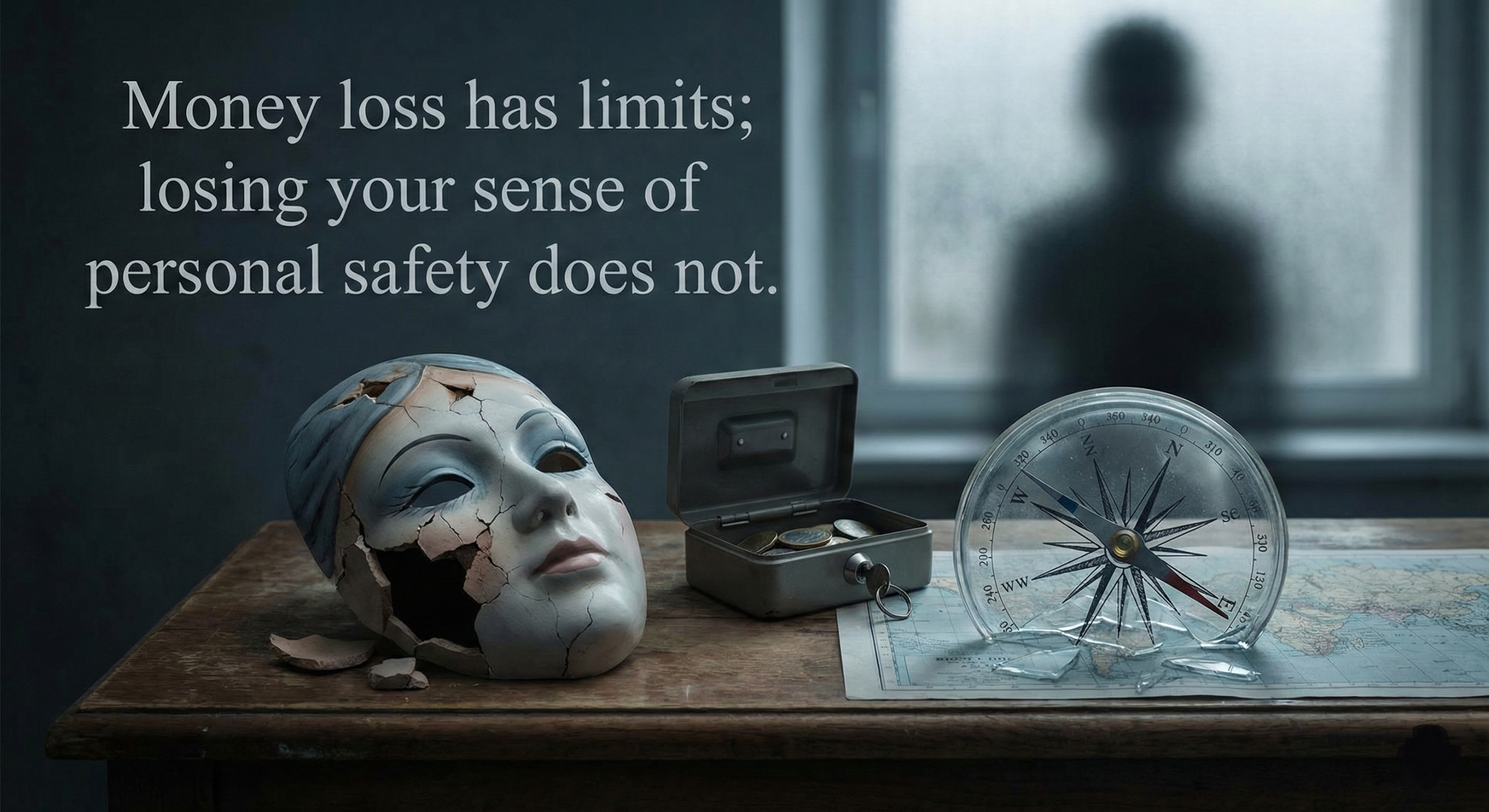
i’ve been trying to explain this to people without sounding dramatic, and i keep failing. so i’m just going to say it the way it feels, not the way it’s supposed to sound.
losing money has edges. numbers. a before and after. you can calculate it, replace it, recover from it. even when it hurts, it eventually stops hurting in the same way. there’s a bottom to it.
this didn’t have a bottom.
what i lost wasn’t cash or gifts or time that could be neatly tallied up. what i lost was something quieter and harder to get back: the feeling that my own judgment was basically reliable. the belief that if someone felt safe, they probably was.
that belief used to be background noise in my life. i didn’t think about it. it just existed. i met people, read situations, trusted myself to notice when something was off. not perfectly, but enough to feel grounded.
after this, that grounding cracked.
the deception wasn’t loud or obvious. that’s the part people struggle to understand. there was no moment where i thought, this person is lying to me. there was no clear manipulation that i could point to and say, see, right there. instead, there was a version of him that felt calm, considerate, almost deliberately unthreatening.
he didn’t rush. didn’t push. didn’t test boundaries in ways that would’ve set off alarms. he did the opposite. he signaled safety. patience. respect. all the things we’re taught to look for, especially when we’re trying to avoid chaos.
and i believed it.
not because i was naïve, but because it was believable.
that’s the part that messes with me the most. i didn’t ignore red flags. there weren’t any yet. what i trusted was a carefully presented version of someone who knew how to appear non-threatening until he no longer needed to.
when that version disappeared, it didn’t just hurt emotionally. it rearranged how i saw myself.
suddenly, i wasn’t just asking, how could he do this?
i was asking, how could i not see it?
that question lodged itself deep.
i replayed conversations. reread messages. remembered early moments that had felt comforting and tried to reinterpret them with hindsight. not to understand him, but to figure out where i went wrong. where my internal compass failed.
and that’s where the damage really lived.
i started second-guessing everything. not just romantic situations, but small, everyday interactions. someone being kind felt suspicious. someone being calm felt potentially performative. i noticed myself scanning for danger in places that used to feel neutral.
even silence felt louder.
it’s exhausting to live like that, constantly evaluating whether your reactions are appropriate or paranoid. whether your discomfort is intuition or trauma talking. whether you’re protecting yourself or just slowly shrinking your world to avoid being wrong again.
money loss doesn’t do that.
money loss doesn’t make you afraid of your own instincts.
what makes this kind of deception worse is that it weaponizes trust itself. it takes the very thing that’s supposed to keep you safe — your ability to read people, to feel grounded in your perceptions — and turns it into something you start to doubt.
i didn’t just lose trust in him. that part was almost easy, once the mask came off. i lost trust in the version of myself who had felt safe around him. the version of me who thought calm meant stable, who thought patience meant respect.
it made me feel foolish in a way that was hard to articulate. not embarrassed, exactly. more like disoriented. like the floor plan of my own mind had been subtly altered and i kept bumping into walls that weren’t there before.
people told me i was lucky i “got out.” and maybe i was. but leaving didn’t immediately restore anything. it didn’t flip a switch where everything made sense again. it just stopped the active harm. the aftermath lingered.
weeks later, i’d still tense up at notifications. still run scenarios in my head. still feel my stomach drop when someone’s tone shifted, even slightly. the relationship was over, but my nervous system didn’t get the memo.
that’s the cost no one talks about.
you can’t reimburse a sense of safety. you can’t transfer funds back into your trust account and call it even. rebuilding that takes time, and it’s uneven. some days you feel almost normal. other days, something small knocks the wind out of you and you’re back in it.
what hurts the most is knowing that the version of him i trusted was never meant to last. it was designed to get close, to lower defenses, to feel safe enough that leaving later would be harder. that realization made everything feel more intentional, even if i don’t know how conscious it was on his part.
i don’t know if he thought of it as deception. i don’t know if he ever saw himself clearly. but i know how carefully that early safety was constructed, and how quickly it vanished when it was no longer useful.
that’s why this feels worse than losing money.
money doesn’t follow you into new rooms. money doesn’t make you flinch when someone raises their voice slightly. money doesn’t make you doubt your right to leave when something feels wrong.
this did.
i’m slowly learning to trust myself again, but it’s not linear. some days i feel strong and clear. other days i catch myself wondering if calm is real or just another costume.
maybe that will fade. maybe it won’t fully.
i don’t have a clean ending here. no redemption arc. just an understanding that the most expensive thing i lost wasn’t something i could ever get back in one piece.
and i’m still figuring out how to live with that without letting it define me.